









Why is DFM So Critical?
An established industry principle holds that up to 80% of a product’s ultimate cost is locked in during the design phase. This means a minor, forward-looking design optimization early on can yield benefits in cost savings, quality improvement, and cycle time reduction that are tens or even hundreds of times greater than incremental improvements made on the production floor. DFM is not a constraint on your creativity; it is the discipline that gives your ideas viable, profitable wings.
The Core Value of DFM: Why Are 80% of Costs Decided by Design?
In product development, a widely validated rule states: up to 80% of a product’s total final cost is determined during its design stage. This figure is not an exaggeration; it reveals the most leveraged decision point in the entire value chain from concept to market.
The key to understanding this lies in recognizing that costs are not merely incurred on purchase orders or production work orders—they are “pre-set” by a series of fundamental, early-stage design choices.
How Does Design “Lock In” Cost?
Material & Process Path Dependency: The materials you select and the manufacturing processes you decide upon directly define the baseline for your supply chain, capital equipment investment, and processing cycle times. This forms the “hard framework” of cost.
The Multiplier Effect of Complexity & Precision: Every non-standard curvature, excessively tight tolerance, or additional assembly step is magnified during manufacturing, translating into more machining time, more expensive tooling, more complex fixtures, and lower yield rates. Complexity is a cost multiplier.
The Irreversible Commitment of Molds & Tooling: For processes like injection molding or die casting, once tooling manufacture begins, most of its cost is already incurred. Design changes requiring mold modifications are far more costly than adjusting lines on an early-stage drawing. This is the most tangible manifestation of cost lock-in.
Setting Supply Chain & Procureability: Design determines the specificity and standardization level of required components. The procurement cost, lead time, and supply chain risk for a highly custom part are essentially predetermined the moment the design is finalized.
The cost of late-stage changes is staggering. Studies show that if a problem is identified and corrected during the design phase, the cost factor is 1. If corrected during prototyping, it might become 10. If discovered on the mass production line, the correction cost can soar to a factor of 1000.
Therefore, the core value of DFM lies in moving the point of cost control as far upstream as possible. It is a form of “virtual production” and “stress testing” conducted in the digital world at the lowest possible cost. Through DFM, we collaboratively identify and optimize risk points at the design stage that could lead to soaring costs, quality fluctuations, or delivery delays later on, transforming “cost lock-in” into “value lock-in.”
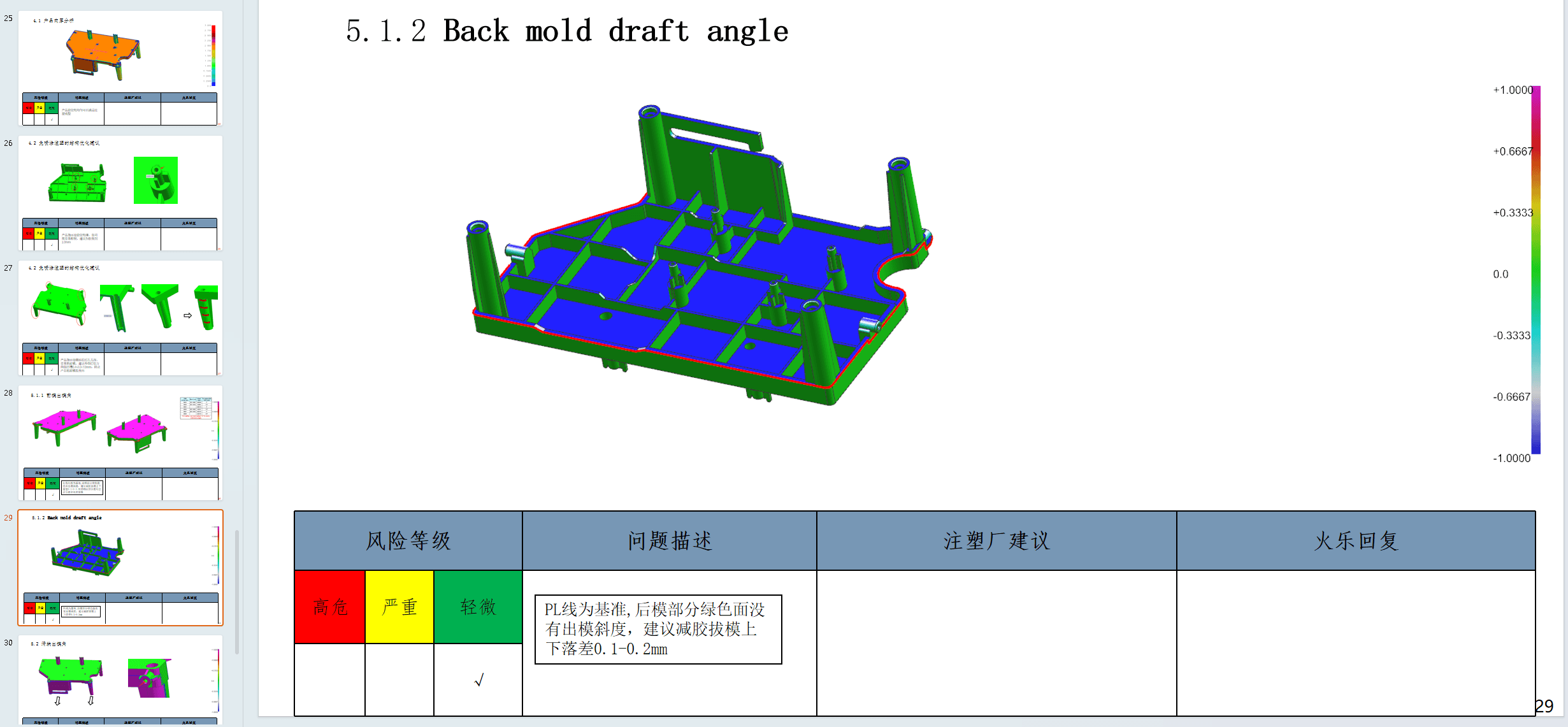
At Leda, our DFM analysis provides you with precisely this kind of “manufacturing lens.” It makes hidden costs visible, adjustable, and controllable before they become reality. This is not merely about reducing manufacturing costs; it is about laying the most deterministic foundation for the commercial success of your product.
From “Manufacturable” to “Efficiently Manufacturable”
Traditional DFM often stops at answering the question, “Can this design be made?” At Leda, we hold ourselves to a higher standard: we are committed to answering, “How can it be made in the optimal way?”
Our Four Pillars of “Efficiently Manufacturable”:
Predictability: Before manufacturing begins, we utilize tools like mold flow analysis, tolerance stack-up analysis, and machining simulation to predict and visualize potential issues (such as short shots, warpage, or interference). This shifts the cost of trial-and-error into the virtual world.
Scalability: We evaluate whether a design can transition smoothly from prototype to mass production. For instance, a delicate prototype requiring manual finishing is “manufacturable,” but a design incorporating guides and error-proofing features for automated assembly is “efficiently manufacturable.”
Affordability: We perform “cost-driver analysis” to identify design features with the greatest impact on total cost (e.g., a non-standard, tiny bore requiring expensive specialty tooling and multiples of the standard machining time). We then collaborate with you to optimize these features, striving for the best balance between performance and cost.
Sustainability: We factor manufacturing efficiency and environmental impact into the equation. A design that is “efficiently manufacturable” also implies less material waste, lower energy consumption, and a more streamlined supply chain.
A Simple Comparison:
A “Manufacturable” answer: “This deep-pocket part can be machined, but it will require a custom extended-length tool and result in very long cycle times.”
An “Efficiently Manufacturable” answer: “We recommend reducing the depth of this pocket by 20% or adding a relief hole at the bottom. This allows the use of standard tooling, reduces machining time by 65%, completely eliminates quality risks from tool chatter, and is projected to lower total cost by 40%. Here is our comparative simulation data.”
Quality is Built In Through Design: Proactive Control from the Start
Traditionally, quality control is seen as an end-of-line activity—filtering out defects through inspection. At Leda, however, our philosophy is that true quality cannot be “inspected into” a product; it must be “designed and manufactured into” it. Our core strategy is to systematically move the quality control gateway upstream to the earliest stages of product development, building a robust “seawall” against defects right at the design source.
Why Must Control Be Moved Upfront?
The cost of a quality issue grows exponentially the later it is discovered. A problem that could be solved by modifying a drawing during the design phase might cost tens of thousands in mold modifications and weeks of delay if found later. If it erupts during mass production, it can trigger line stoppages, batch scrapping, customer complaints, and even catastrophic damage to brand reputation. Therefore, the most economical and effective investment in quality is to eliminate all known risks before the first physical part is ever made.
How Does Leda Achieve “Quality Upfront”?
Failure Prevention-Driven Design Reviews: We go beyond checking drawing compliance. Employing a Failure Mode and Effects Analysis (FMEA) mindset, we systematically challenge the design: Will this thin wall be prone to short shots during injection? Could this sharp corner become an origin point for fatigue cracks under stress? Might this assembly gap fail under temperature variation? By simulating and answering these questions during design, we proactively prevent failure rather than react to it.
Designing for Manufacturing Process Robustness: We understand that production environments have inherent variability. Our DFM analysis focuses on optimizing designs to be more forgiving of inevitable process fluctuations—like material batch differences, minor tool wear, or ambient temperature changes. For instance, we modify geometries to reduce sensitivity to injection pressure or machining clamping force, ensuring consistent output of good parts within the defined process window.
Design as Data, Data as Control: We translate design intent into actionable, data-driven quality control points. Critical dimensions and tolerances are not just annotated on drawings; they are directly linked to the programming of our Statistical Process Control (SPC) systems and fully automated inspection equipment. This means that from the very first prototype, we collect data, verify process capability, and ensure the “quality” defined by the design can be achieved consistently and precisely.
Cost is Defined by Design: A Total Cost of Ownership Perspective
Our focus extends beyond the unit price of a component to its Total Cost of Ownership (TCO). This encompasses mold/tooling investment, production yield, assembly efficiency, maintenance costs, and even end-of-life disposal. During the DFM phase, we collaborate with you on “cost simulation,” revealing how different design choices impact costs across the entire value chain. For instance, adding a feature might reduce machining cost but increase mold complexity; relaxing a tolerance could significantly improve yield. We provide data-driven insights to support your most economical business decisions.
At Leda, we understand your focus on the “unit price” of a part. However, our professional insight tells us that true cost control begins with the systematic management of Total Cost of Ownership. A seemingly attractive low unit price may hide substantial mold investment, poor production yield, complex assembly processes, or frequent field failures. Therefore, a core mission of our DFM process is to work with you to navigate beyond the simplicity of a unit price quote, to transparently analyze and optimize the total lifecycle cost of your product—from concept to retirement.
Leda DFM Service Workflow: From File Upload to Production Release
Stage 1: Instant Analysis & Preliminary Feedback (Within Hours)
Your Action: Upload your 3D models, 2D drawings, and technical requirements via Leda’s online collaboration platform.
Leda’s Action: Our platform automatically triggers an analysis. Combining AI algorithms with our core manufacturing rules database, the system generates a preliminary Design for Manufacturing (DFM) report and provides an instant, geometry-based quotation within hours. This report highlights potential “Red Alerts” (e.g., unmanufacturable features, clear rule violations) and “Yellow Flags” (designs that may increase cost or risk).
Deliverables: Preliminary DFM Report, Instant Project Quotation, and your dedicated Project Manager’s contact details. This provides you with a rapid feasibility assessment and budget foundation.
Stage 2: In-Depth Engineering Review & Collaborative Workshop (1-3 Business Days)
Your Action: Confirm the start of the in-depth review and prepare your design team (mechanical, electrical, etc.) for technical discussions.
Leda’s Action: Your dedicated Project Manager coordinates internal resources to form a cross-functional engineering team (including process, tooling, and quality engineers). This team conducts a detailed manual review of your design and may initiate specialized engineering simulations. We then schedule an online or on-site collaborative workshop to discuss design details, functional requirements, potential risks, and optimization paths item-by-item with your team.
Deliverables: Detailed DFM Review Meeting Notes, Simulation Analysis Reports (if applicable), and a mutually agreed-upon list of key issues & optimization directions.
Stage 3: Optimization, Joint Decision-Making & Design Freeze (Typically 3-7 Business Days)
Your Action: Implement design adjustments based on the review feedback, with support from the Leda team.
Leda’s Action: Based on workshop conclusions, we prepare a formal DFM Optimization Proposal containing multiple comparative solutions. This document clearly outlines different optimization paths (e.g., Option A focuses on cost, Option B on performance) along with a quantified impact assessment on tooling investment, unit cost, production lead time, and product performance. We review these options with you to support the final decision that best aligns with your project goals.
Deliverables: Formal DFM Optimization Proposal, Final Design Change List, and a jointly signed Design Freeze document. This marks the end of the design phase and the beginning of manufacturing preparation.
Stage 4: Seamless Data Handover & Production Readiness
Your Action: Confirm the final design data package.
Leda’s Action: The approved design data (3D/2D) is securely and completely transferred into our Manufacturing Execution System (MES). Crucially, all knowledge generated throughout the DFM process—including key quality control points, special process parameters, and assembly notes—is systematically translated into production control plans, work instructions, and inspection protocols. These documents will directly guide our tooling fabrication, production, and quality inspection, ensuring the design intent we optimized together is faithfully realized in mass production.
Deliverables: Formal production launch confirmation, production schedule, and subsequent standard deliverables including tooling fabrication, First Article Inspection, production ramp-up, and ultimately, successful product mass production release.