










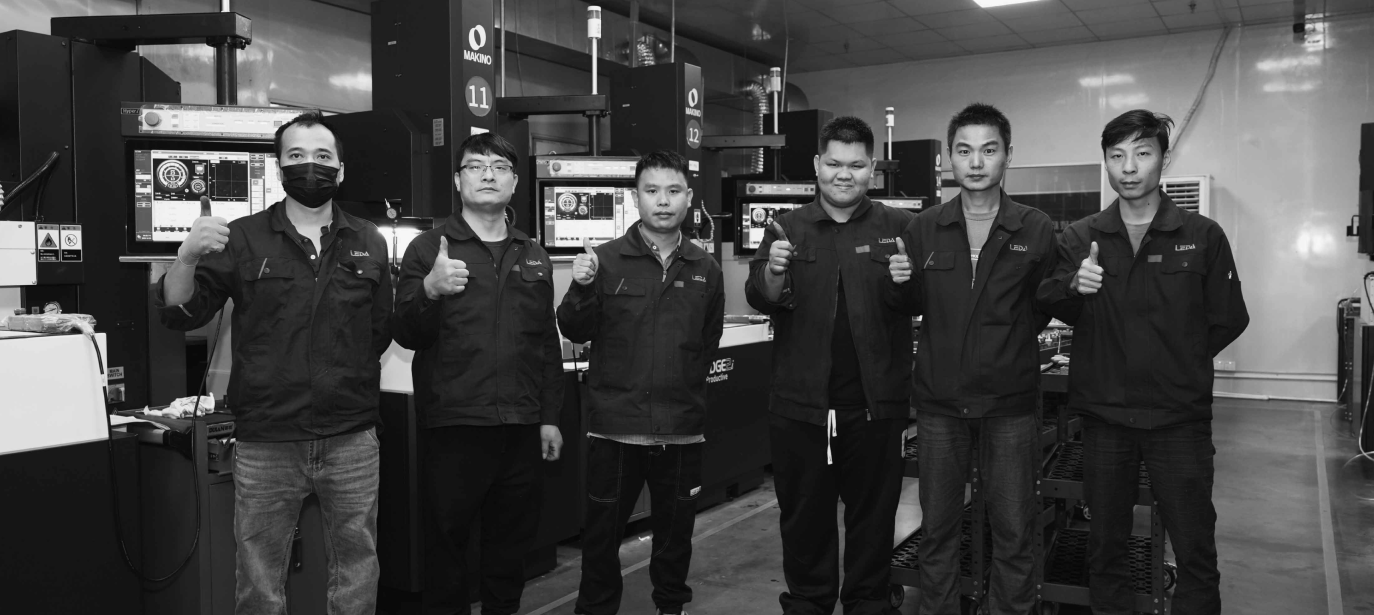

Deconstructing NPI Success from an R&D Perspective: The Hardware Innovator's Guide to a Deterministic Manufacturing Partner
Abstract
The New Product Introduction (NPI) phase is the critical leap from virtual concept to physical reality in hardware development. Yet, this journey is fraught with uncertainties in technology, cost, and timeline. Based on in-depth dialogues with numerous hardware R&D leaders, this white paper systematically analyzes the core pain points across each NPI stage. It concludes that the traditional “order-taking” model is obsolete. The key to success lies in forging a strategic partnership with a manufacturing partner capable of providing deterministic input, engaging in deep collaboration, and possessing “production DNA.” Guided by the principle “Your Vision, Our Precision,” LEDA Precision aims to be the trusted “external manufacturing brain” for R&D teams through systematic support across the entire NPI lifecycle, enabling the efficient and reliable transformation of innovative visions into market success.
Introduction: The NPI Dilemma – The “Certainty Black Hole” from an R&D Lens
For hardware R&D teams, the greatest challenge often lies not in the idea itself, but in the complex process of turning it into a mass-producible, stable, and cost-effective physical product. The NPI stage can resemble an uncertain “black hole,” consuming budget, time, and team morale. What innovators need is not merely a “supplier” to execute drawings, but a navigator and co-creator who can illuminate the path and transform the unknown into the known.
Part 1: Deep Dive into Core Pain Points Across the NPI Lifecycle
Phase 1: Design Stage – The Gulf Between “Ideal Model” and “Manufacturable Design”
Pain Point: R&D focuses on functionality and performance optimization, often lacking sufficient insight into manufacturability, cost sensitivity, and production feasibility. Design reviews remain theoretical, sowing seeds for delays and cost overruns.
The R&D Voice: “My design is perfect in simulation, but the vendor says it’s unmakable or prohibitively expensive. We have to rework, severely delaying the project.”
Phase 2: Prototype Validation – The Dilemma of “Fidelity” vs. “Iteration Speed”
Pain Point: Prototypes often prove “form” but not “function”—failing to replicate production materials, processes, or performance. Long, costly iteration cycles force teams to reduce validation rounds, allowing critical issues to surface only later, at great expense.
The R&D Voice: “To save time, we used a 3D-printed part for functional testing. Its performance differed vastly from the final injection-molded part, invalidating all test results and forcing a restart.”
Phase 3: Testing & Process Lock – The Anxiety of “Can We Scale?”
Pain Point: Even with a successful prototype, pilot production (Trial Run) remains a “leap of faith.” Is the process stable? Can yield targets be met? Is the supply chain reliable? Decisions without data support feel like gambling.
The R&D Voice: “The sample was manually adjusted. On the production line, issues emerged endlessly. We couldn’t tell if it was a design flaw or process instability, stuck in a debugging loop.”
Phase 4: Production Ramp & Handover – Risks of “Knowledge Gaps” & “Quality Drift”
Pain Point: Critical tacit knowledge (Know-how) and empirical data are lost during the handoff from R&D to manufacturing. Quality fluctuates during ramp-up, pulling R&D into “fire-fighting” mode and stalling new projects.
The R&D Voice: “The product finally ‘successfully’ ramped, but our team is ‘locked in,’ constantly handling line issues. R&D progress has completely halted.”
Part 2: The Required Shift in Support Paradigm: From “Supplier” to “Deterministic Partner”
To address these pain points, R&D needs a manufacturing partner that delivers “Certainty”:
Process Certainty: Clear, transparent, and predictable project milestones and delivery timelines.
Quality Certainty: Reproducible process capability and product quality backed by data (CPK, GR&R).
Cost Certainty: Reliable cost modeling early in the design phase, preventing late-stage “cost shocks.”
Knowledge Certainty: Systematic manufacturing input and seamless knowledge transfer.
Part 3: The LEDA Precision NPI Enablement Framework – Delivering “Certainty” with “Precision”
Based on a deep understanding of R&D challenges, LEDA Precision has built an enablement framework that injects our core competency—“Precision”—into every stage of your innovation cycle.
1. Design Collaboration: Front-Loading Manufacturing Intelligence
Deep DFM/A Analysis: We engage during conceptual and detailed design, providing expert reports on material selection, tolerance allocation, structural optimization, and assembly simplification—solving problems on the drawing board.
Cost & Process Simulation: We compare different design schemes and process routes (e.g., CNC vs. Molding), enabling informed trade-offs between cost, timeline, and performance from the outset.
2. Prototype Acceleration: Creating a “High-Fidelity” Validation Loop
Multi-Process Rapid Prototyping: We integrate CNC (±0.005mm precision), industrial 3D printing, and rapid tooling to deliver “engineering-grade” prototypes tailored for functional, assembly, or testing validation.
Scalable Process Paths: We ensure prototype processes can transition smoothly to production, preventing performance deviations due to工艺 changes.
3. Pilot Run & Validation: Laying a Data-Driven Foundation for Production
Data-Driven Process Window Locking: We use Design of Experiments (DOE) to optimize key parameters, identifying robust production windows beyond artisan经验.
Process Capability Certification: During pilot runs, we implement rigorous Statistical Process Control (SPC), reporting CPK for critical dimensions to objectively prove production feasibility.
Supply Chain Pre-Qualification: We ensure specialty materials and supply chains from the pilot phase are scalable for volume production.
4. Production Ramp & Sustained Support: Ensuring a Smooth Landing
Complete Manufacturing Data Package Handover: We provide standardized documentation including drawings, Process Flow Charts, Control Plans, Work Instructions, and maintenance manuals for “lossless” knowledge transfer.
“Prototype-Mold-Volume” One-Stop Service: A single project team guides your product from the first sample to million-unit production, ensuring quality and process consistency while drastically reducing handover risks.
Full Lifecycle Data Traceability: Our digital system enables end-to-end traceability from raw material to finished product, supporting continuous improvement and root-cause analysis.
Conclusion: Establishing a New NPI Paradigm Centered on Certainty
Competition in hardware innovation is fundamentally about efficiency and reliability. Selecting a true manufacturing partner is one of the most critical strategic decisions in the NPI phase.
At LEDA Precision, we believe “Precision” is not just about microscopic dimensional control, but about the precise management and commitment to the entire NPI process. We are dedicated to minimizing uncertainty through deep front-end collaboration, high-fidelity rapid validation, data-driven process development, and seamless production ramp-up, transforming your “Vision” into market success with determinism.
Let’s work together to build a certain path from blueprint to market for every innovative idea.
About LEDA Precision
LEDA Precision is a global manufacturing solutions partner, specializing in providing hardware innovators with a one-stop service from precision rapid prototyping and mold development to scaled production. With “Your Vision, Our Precision” as our core promise, we leverage advanced manufacturing technology, deep engineering collaboration, and rigorous quality systems to help customers accelerate time-to-market and reduce total lifecycle cost.
Contact us today for a dedicated NPI capability assessment and solution consultation.